
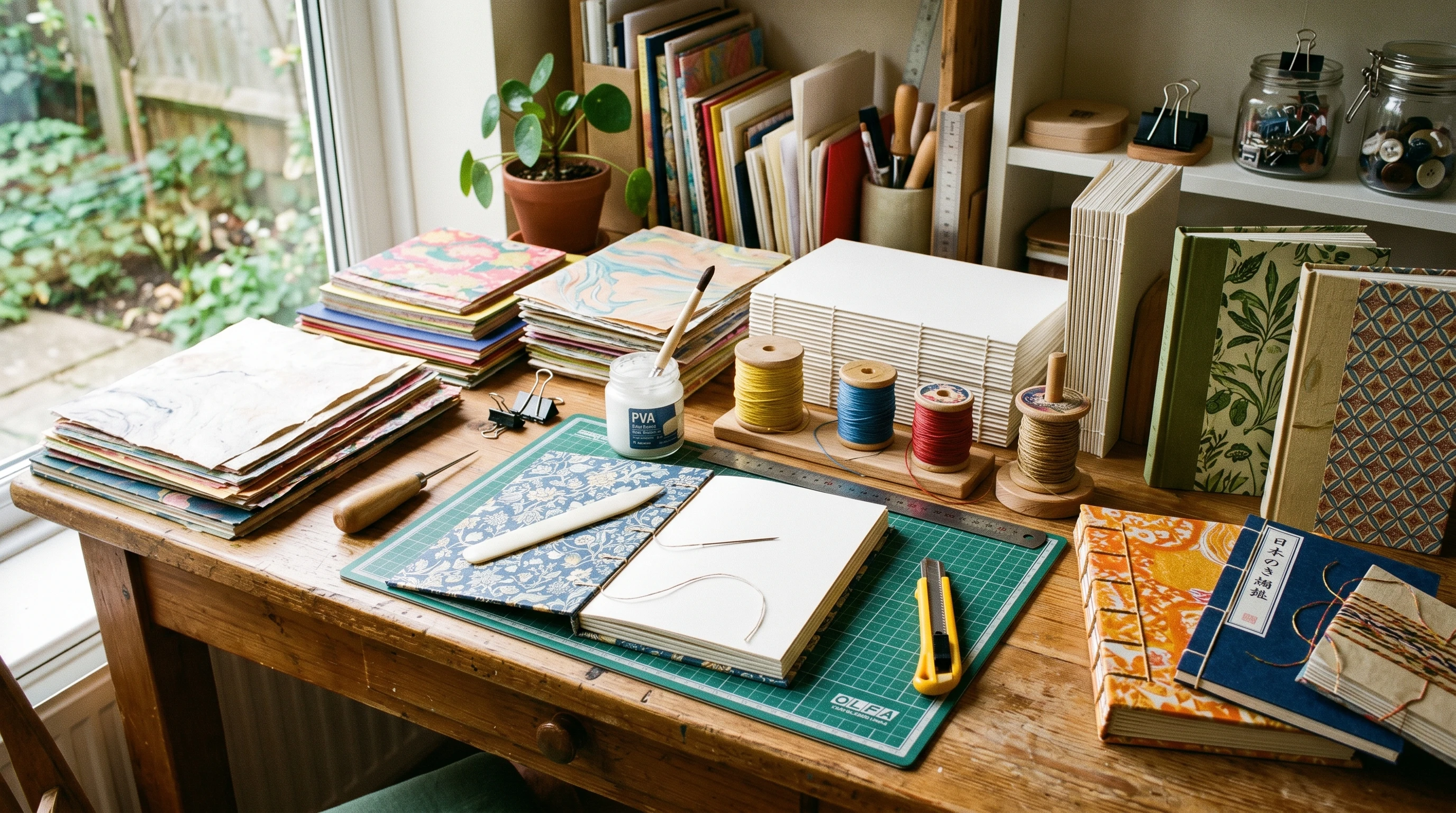
For art enthusiasts, beginners, and hobbyists, creating a personalized sketchbook can make your creative process more enjoyable and tailored to your style. Making your own sketchbook is fun and allows you to customize everything from paper type to cover design, keeping your project engaging from start to finish.
I put together this easy-to-follow guide to help anyone, even beginners, make a sketchbook that feels just right, encouraging a sense of possibility and motivation.
Step 1: Figure Out What You Want Your Sketchbook to Be
Before grabbing your supplies, it helps you to know a few basics about what you want in a sketchbook. There’s a big difference between one made for quick doodles and one built for heavy watercolor washes!
Things to Consider:
- What size do you want? (Pocket, A5, A4, or even custom)
- What type of paper will you use most? (Smooth for ink, textured for pencils, thick for painting)
- How many pages do you want?
- Style—do you want a hardcover, softcover, or something flexible?
- How portable does it need to be?
Once you have a vision, it is much simpler to round up exactly what you will need before putting your sketchbook together. You might even sketch out your ideal sketchbook on a scrap piece of paper to help plan the details.
Step 2: Gather Your Materials
You do not need any fancy bookbinding equipment to get started. You can find most of the basic supplies at a local art store or even around your house. Here is what I use for most DIY sketchbooks:
- Paper (art paper, watercolor paper, drawing paper, recycled printer paper—your pick)
- Cardboard or chipboard (for the cover, old cereal boxes work in a pinch!)
- Decorative paper, fabric, or even wallpaper for the outside cover
- Glue stick or PVA glue
- Heavy-duty thread, embroidery floss, or waxed twine
- Needle (an embroidery needle is excellent)
- Scissors or utility knife
- Ruler and pencil
- Binder clips
- Bone folder or the back of a spoon (for creasing paper, optional but handy)
- Rubber band or hair tie (optional if you want to keep the sketchbook closed)
If possible, buy acid-free materials, as they will help your art last longer. But if you are starting, whatever you have in hand is totally fine. Some people even repurpose paper scraps or use brown kraft paper for a rustic feel. You could even mix in a few colored pages or tracing sheets to make things more interesting.
Step 3: Decide on Binding Style
How you put your sketchbook together changes the look, feel, and how flat the pages will lie. Here are a few binding methods that are easy to do at home:
- Staple Binding– Quickest method. Just fold sheets in half and staple along the crease. Not the prettiest, but practical.
- Coptic Stitch Binding – Popular for DIY sketchbooks because the pages lie totally flat. A little more effort, but worth it to learn.
- Simple Pamphlet Stitch – Needs just a needle and thread. Super easy and ideal for smaller books.
- Ring Binding – A hole punch and binder rings or discs. Makes it easy to add or remove pages.
If you are just getting started, the pamphlet stitch is a fantastic beginner method. It is easy, sturdy, and gives that handmade vibe. If you are feeling ambitious, check out online tutorials for Coptic stitch binding—these will give you extra style points and let your sketchbook lie perfectly open.
Step 4: Prep and Fold Your Paper
Grab your chosen paper and count out as many sheets as you want. For a simple book, 10–20 sheets work well (that is, 20–40 pages once folded). Trim the paper to your desired size using a ruler and craft knife—or scissors if you are working with smaller paper. Do not be afraid to try unique sizes or even make a mini sketchbook for on-the-go creativity.
How to Fold:
- Carefully fold each sheet in half for a clean crease. Use your fingers, the back of a spoon, or a bone folder for a sharper crease.
- Group your folded sheets into small stacks called signatures (groups of 3–5 folded sheets work best). This process makes your book open better and can handle more pages.
If you want thick watercolor paper, try fewer sheets per signature, since thicker paper stacks up fast. You can also mix in tracing paper or colored sheets to step up the look of your book.
Step 5: Make the Cover
Your cover protects your art, but it’s also a great spot to show off your personality. You can make a cover out of cardboard, chipboard, or even heavy cardstock. Recycled materials, like food packaging or old folders, can add unique character to your finished sketchbook.
How to Make a Simple Cover:
- Cut your cardboard to just a little bigger than your folded pages (about 1/4 inch extra on each side works well).
- Wrap with pretty paper or fabric; glue it tight and smooth out any wrinkles.
- Let the glue dry before working with it further.
- Decorate! Paint, stamp, doodle, or collage—it is totally your call. Try using washi tape, stickers, or your own illustrations to add extra flair to the cover.
If you want a flexible cover, use heavy decorative paper or even plastic for spill resistance. Consider adding a pocket to the front or back cover to hold loose sketches, notes, or business cards.
Step 6: Bind Everything Together
Once you have sorted out your pages and your cover is ready, it is time to assemble. Here is a simple pamphlet stitch walkthrough:
1. Assemble your signatures inside the cover. Use binder clips to hold everything together.
2. Use a push pin or needle to poke three evenly spaced holes along the fold (top, middle, and bottom).
3. Thread your needle and start from the inside center hole. Push out to the outside, up to the top hole, back to the middle, down to the bottom, then back inside through the center. Pull tight and tie securely.
4. Trim the thread ends and remove the binder clips when finished.
Want to step up your book’s durability? Add more signatures and connect them using a Coptic or long-stitch method. If you are more hands-on, check out detailed video guides for advanced techniques. There is always more to learn, and your skills will only get better with each handmade book.
Step 7: Add Some Finishing Touches
These touches are the part I love most! Your DIY sketchbook is ready for cool upgrades if you want:
- Add a ribbon or elastic for closure
- Glue a pocket onto the inside cover for loose sketches or reference photos
- Label the front or “spine” of your book
- Paste in bookmarks, pen loops, or add tabs to separate sections
The beauty of making your own sketchbook is that it can be as plain or as eye-catching as you want. Some folks even add envelopes or intersections to hold tickets and find objects. There is no wrong way to get creative with your book!
Common Questions and Troubleshooting:
What if my pages stick out unevenly?
It happens! Take the assembled, finished book and use a sharp knife (and a ruler) to trim the edges carefully. Go slow and make sure your blade is sharp for the best results. A little patience pays off for a clean look.
My sketchbook won’t stay closed. What should I do?
- Wrap a rubber band or ribbon around it.
- Use an elastic strip attached to the back cover and loop it forward.
- Get creative: attach a vintage button for a stylish closure.
Can I add more pages later?
With pamphlets or staple-bound books, it’s tough. Ring binding is great if you want to add or swap out pages over time.
How do I waterproof my cover?
Try using clear packing tape, a layer of waterproof glue, or laminate sheets for extra toughness. Let everything dry completely before you start using your sketchbook, so it stays strong and lasts.
Tips and Ideas for Customization
- Mix blank, lined, or colored papers for different sections within your book.
- Use recycled pages from old sketchbooks or notebooks.
- Add inspiring quotes, stickers, or washi tape to your covers and pages.
- Try different shapes: circle, square, or even an oval sketchbook.
- Mount a pen holder using elastic, so you are never without a pen.
- Add page numbers, an index, or a pocket for collecting inspiration on the go.
The more you experiment, the better your homemade books will turn out. There is something so satisfying about creating in a book you made yourself and designed to fit exactly how you work. It rewards your creativity and helps you develop a style that’s truly your own.
Quick Start Checklist:
1. Pick your paper and cover material.
2. Decide the size and binding style.
3. Gather basic tools: scissors, thread, needle, and glue.
4. Assemble your pages, add the cover, and bind them together.
5. Customize, decorate, and fill with your art!
Trying out DIY sketchbooks is a fantastic way to make your art routine even more personal and meaningful. Got a favorite technique or supply? Share your process and ideas; there is always something new to pick up in the world of handmade books.

I’ve been helping my sister with her sketchbook, and this guide is an excellent resource! I love how you broke down the different binding styles and suggested beginner-friendly options like the pamphlet stitch; it makes the whole process feel less intimidating. I know she’ll enjoy customizing the cover with recycled materials and adding pockets for loose sketches.
For someone who likes to experiment with watercolor and ink in the same book, do you think it’s better to mix different paper types in one sketchbook or to keep separate books for each medium?
Thank you, Celia, for your uplifting comment.
It is your preference whether to put different types of paper in the same book or keep the same paper in separate books. I personally keep some of my work in the same book, but depending on what medium I am using, I switch to a different book.
When using watercolors, watercolor pencils, alcohol inks, alcohol markers, and markers, you want to use mixed media or watercolor paper for its thickness and its ability to handle liquids. Anything lighter will seep and bleed through.
You can use dry media such as graphite pencils, pastels, charcoal, colored pencils, micron pens, gel pens, drawing pens, and ballpoint pens on mixed media, watercolor, and or drawing paper. Some sketch papers are thicker, like drawing paper, than others I have found. Just be careful when using thin sketch paper; you want to draw on it lightly because, if you draw boldly and then erase, you may make a hole in the paper. I use thin sketch paper when planning my next drawing or journaling.
I hope I answered your question by giving suggestions on what I personally use and do.
All my best to you,
Heidi